NAV: cloud for builders
2026Infrastructure
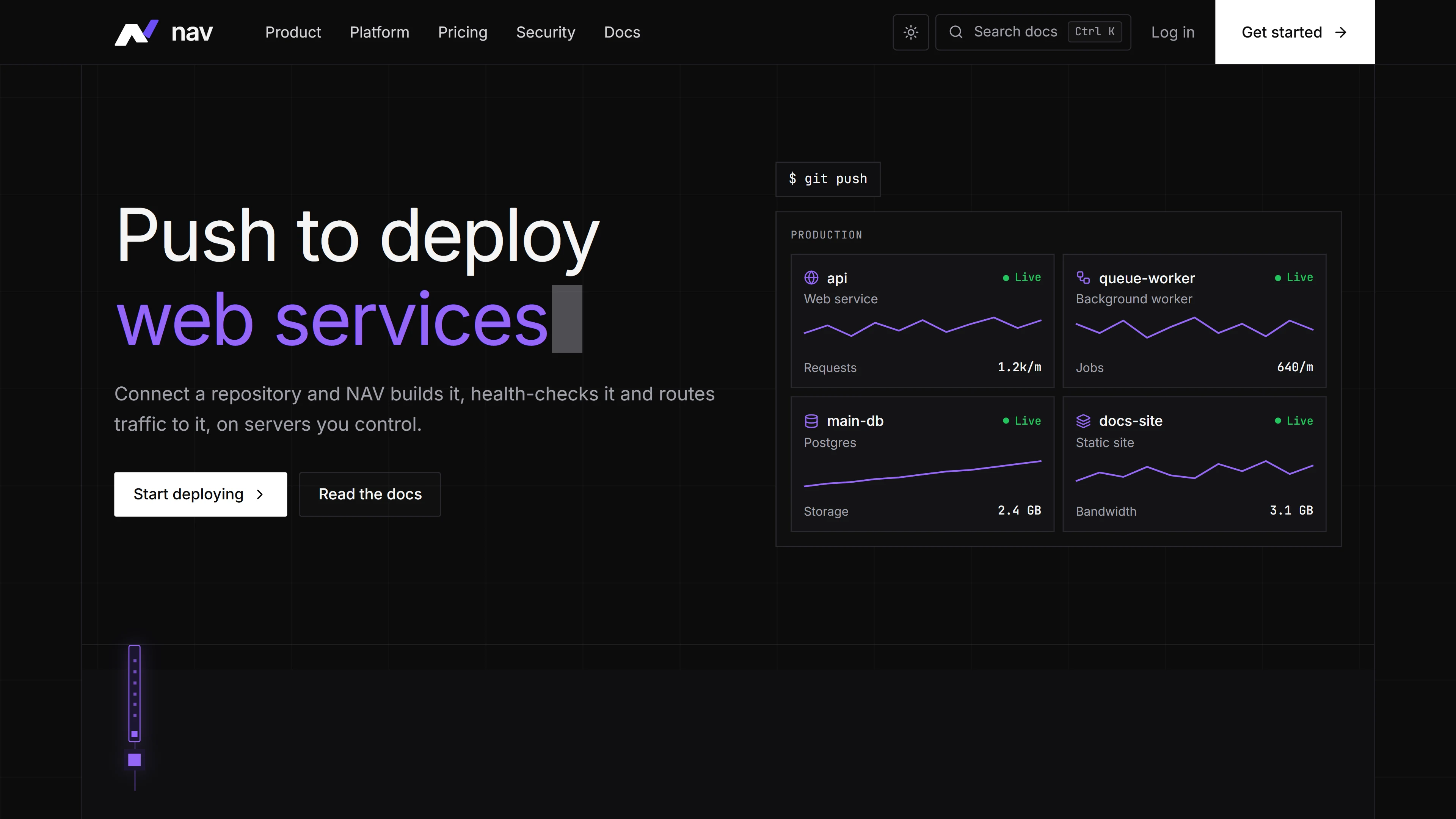
newA self-hostable platform for deploying apps: connect a Git repo and NAV builds it, runs it behind its own TLS edge, and handles logs, metrics, scaling, rollbacks, cron, databases and custom domains.
Problem
Shipping a side project means stitching together a host, a database, TLS, cron, logs and a deploy pipeline, and paying for each piece. I wanted one platform I control that does all of it on a single server.
Solution
NAV is a full platform-as-a-service. A control plane exposes a REST and live-streaming API with auth, role-based access and GitHub integration, plus a scheduler for cron jobs, autoscaling, reconciliation, retention and backups. All coordination runs through PostgreSQL: a job queue built on row locks, and live notifications that stream logs, state and routing changes to the dashboard. A node agent clones each repo, detects the runtime (Node, Python, Go, Ruby, Bun or a Dockerfile), builds it, health-checks the new instances and switches traffic atomically, so deploys have zero downtime and rollbacks reuse the stored build. It also supervises instances, runs health checks, collects metrics and provisions PostgreSQL clusters. A custom edge does reverse proxying, load balancing, SNI-based TLS with automatic certificates, and static site serving. Services, workers, cron jobs, durable workflows, databases and domains can all be declared in a nav.yaml file, and there is a dashboard and a nav command-line client on top.
Outcome
One command installs NAV on a fresh Ubuntu server. An end-to-end suite deploys real apps from Git and checks crash self-healing, scaling with round-robin routing, zero-downtime redeploys, rollbacks without rebuilding, custom domains with TLS, cron, database backup and restore, and full blueprint syncs.